星期四, 7月 03, 2008
Optical Illusion
Animated Optical Illusion! - The funniest bloopers are right here
It is a cool video !!! It is also amazing that the producer can earn 900+ US for all the video he posted.

星期四, 1月 17, 2008
Video Vortex
After looking at the Video documentation for all presentations at the Video Vortex Brussels conference on 5 October 2007 in Argo blogs, I am very excited to look at the new round of video vortex.
Tmr at Amsterdam,Video Vortex Conference opens.
Here is the introduction :
In response to the increasing potential for video to become a significant form of personal media on the Internet, this conference examines the key issues that are emerging around the independent production and distribution of online video content. What are artists and activists responses to the popularity of ‘user-generated content’ websites? Is corporate backlash imminent?
After years of talk about digital conversions and crossmedia platforms we are now witnessing the merger of the Internet and television at a pace that no one predicted. For the baby boom generation, that currently forms the film and television establishment, the media organisations and conglomerates, this unfolds as a complete nightmare. Not only because of copyright issues but increasingly due to the shift of audience to vlogging and video-sharing websites as part of the development of a broader participatory culture.
The Video Vortex conference aims to contextualize these latest developments through presenting continuities and discontinuities in the artistic, activist and mainstream perspective of the last few decades. Unlike the way online video presents itself as the latest and greatest, there are long threads to be woven into the history of visual art, cinema and documentary production. The rise of the database as the dominant form of storing and accessing cultural artifacts has a rich tradition that still needs to be explored. The conference aims to raise the following questions:
How are people utilising the potential to independently produce and distribute independent video content on the Internet?
What are the alternatives to the proprietary standards currently being developed?
What are the commercial objectives that mass media is imposing on user-generated content and video-sharing databases?
What is the underlying economics of online video in the age of unlimited uploads?
How autonomous are vloggers within the broader domain of mass media?
How are cinema, television and video art being affected by the development of a ubiquitous online video practice?
What type of aesthetic and narrative issues does the database pose for online video practice?
The closing session on Saturday evening will explore the way VJs and media artists are accessing and using online archives. Under the banner of Video Slamming, this evening is all about the new ways of watching, using, and playing with moving images, such as scratching, sampling, mixing, (meta)tagging and recommending.
Tmr at Amsterdam,Video Vortex Conference opens.
Here is the introduction :
In response to the increasing potential for video to become a significant form of personal media on the Internet, this conference examines the key issues that are emerging around the independent production and distribution of online video content. What are artists and activists responses to the popularity of ‘user-generated content’ websites? Is corporate backlash imminent?
After years of talk about digital conversions and crossmedia platforms we are now witnessing the merger of the Internet and television at a pace that no one predicted. For the baby boom generation, that currently forms the film and television establishment, the media organisations and conglomerates, this unfolds as a complete nightmare. Not only because of copyright issues but increasingly due to the shift of audience to vlogging and video-sharing websites as part of the development of a broader participatory culture.
The Video Vortex conference aims to contextualize these latest developments through presenting continuities and discontinuities in the artistic, activist and mainstream perspective of the last few decades. Unlike the way online video presents itself as the latest and greatest, there are long threads to be woven into the history of visual art, cinema and documentary production. The rise of the database as the dominant form of storing and accessing cultural artifacts has a rich tradition that still needs to be explored. The conference aims to raise the following questions:
How are people utilising the potential to independently produce and distribute independent video content on the Internet?
What are the alternatives to the proprietary standards currently being developed?
What are the commercial objectives that mass media is imposing on user-generated content and video-sharing databases?
What is the underlying economics of online video in the age of unlimited uploads?
How autonomous are vloggers within the broader domain of mass media?
How are cinema, television and video art being affected by the development of a ubiquitous online video practice?
What type of aesthetic and narrative issues does the database pose for online video practice?
The closing session on Saturday evening will explore the way VJs and media artists are accessing and using online archives. Under the banner of Video Slamming, this evening is all about the new ways of watching, using, and playing with moving images, such as scratching, sampling, mixing, (meta)tagging and recommending.
星期三, 1月 10, 2007
Tank TV: I Am Future Melancholic
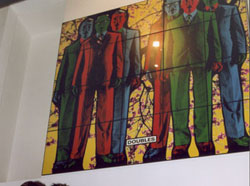
This show presents moving images by artists whose practice reflects a vision of tomorrow. The structures and systems of reality are examined to reveal glimpses into what we call 'the future'. This ineffable and intangible concept, that constantly haunts the present, here provokes a wealth of musings and imaginings.
tank.tv announce in addition to its online exhibition a screening at the Tate Modern, 20 January. The Artist Mathieu Delvaux, Matthieu Laurette and Susanne Bürner with musician Steve Trafford (ex member of the Fall / member of Tycoons Follies), will also be present to introduce their work.
In 'Bruxelles 4023', Mathieu Delvaux & Xavier van Huffel perform street interviews to ask the public what they think Brussels might be like in 4023. The answers, as varied as the people themselves, reveal the concept of the future as a screen for hopes, fears and fantasy. Astarting point into an exploration of tomorrow...
Challenging, doubt-inducing and transformative aspects of 'the future' can be perceived in Vito Acconci's repetitive acts, recorded in a super8 film 'Break-Through' or in Philippe Meste's detonative video 'LHRB'. Rachel Reupke's 'Infrastructure' is born of a fascination with movie special effects and narrative devices. And Carsten Höller's 'One minute of doubt' and 'Punktefilm' induct a representation of our 'timeless everyday', and magically echo the playful nature of his present turbine hall insta llation. Laurent Montaron shows us a fictive exploration of time and travel through his `Readings', while Matthieu Laurette's impressive cocktail of celebrity lookalikes brings us into confusion at a blured vision of the limits between performance and observation. Mai Yamashita and Naoto Kobayashi's star, in 'When I wish Upon a Star' gives us time we need to wish upon.
Artists include: Erwin Wurm, Haris Epaminonda, Xavier Veilhan, Carsten Höller, Philippe Meste, Susanne Bürner, Laurent Montaron, Chris Cornish, Mathieu Delvaux & Xavier Van Huffel, Bernard Gigounon, Matthieu Laurette, Rachel Reupke, John Latham, Vito Acconci and Mai Yamashita & Naoto Kobayashi.
"I am Future Melancholic" is at Tate Modern at 7pm on Saturday 20 January 2007 and online on www.tank.tv from 15 January to 28 February 2007.
Curated by Anne-Sophie Dinant and Laure Prouvost
星期五, 12月 22, 2006
Class for Sex and industrial design
Wouldn't it be fun to have a real class in Hong Kong? The online class Design Areobics is offer by Design Boom.
sex, one of the most basic human acts and instincts, is a main topic of exploration for many talented people in the creation of artwork. this course is not about hardcore pornography. it’s about the way we portray sex, through our creative process. lessons feature thought provoking essays and inspiring examples from art, to photography, to graphic- and industrial
design.
course introduction: 10 lessons
Lesson 1:
sex(taboo subject in society?)
sex, one of the most basic human acts and instincts, is a main topic of exploration for many talented people in the creation of artwork. this course is not about hardcore pornography. it’s about the way we portray sex, through our creative process. lessons feature thought provoking essays and inspiring examples from art, to photography, to graphic- and industrial
design.
course introduction: 10 lessons
Lesson 1:
sex(taboo subject in society?)
Lesson 2:
the boundaries of politically correct(normalization of pornography)
Lesson 3:
'sex sells'(how advertising walks the fine line between prudish and vulgar imagery).
Lesson 4:
banned advertising
Lesson 5:
some things never change(sex, drugs and rock’n roll)
Lesson 6:
history of the nude
Lesson 7:
skin
Lesson 8:
mirrors
Lesson 9:
beauty
Lesson 10:
beate uhse
(the queen of sex shops)
creativity skills / general training practise: 10 lessons
---
Lesson 11:
hedonism
Lesson 12:
sexual appeal
Lesson 13:
compulsively visual and tactile
Lesson 14:
highly overt versus extremely subtle
Lesson 15:
magazine covers
Lesson 16:
fucking brilliant or just a shitty idea?
Lesson 17:
obsession and fantasy
Lesson 18:
seductive paradoxes
Lesson 19:
the condom
Lesson 20:
togetherness
sex in the design context: 10 lessons
---
Lesson 21:
in the realm of the senses(sex and graphic design)
Lesson 22:
design is his way(sex and typography)
Lesson 23:
porno or erotic art?(sex and photography)
Lesson 24:
in everyday life(sex and design)
Lesson 25:
the lolita phenomenon(sex and fashion)
Lesson 26:
adornment and body modification(sex and jewelry)
Lesson 27:
the phallus(sex and architecture)
Lesson 28:
aphrodisiacs(sex and food)
Lesson 29:
in the social swim(sex and interior design)
Lesson 30:
high end tools(sex toys by designers)
星期五, 12月 15, 2006
Download Italian Art book-The Net as an Artwork
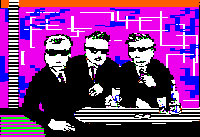
The book represents a first tentative reconstruction of the history of artistic networking in Italy, through an analysis of the realities which during the past twenty years have given way to a creative, shared and aware use of technologies, from video to computers, contributing to the formation of Italian hacker communities.
Written by Tatiana Bazzichelli, with the preface of Derrick De Kerckhove and the epilogue of the videoartist Simonetta Fadda.
Networking means to create nets of relations, by sharing experiences and ideas in order to communicate and experiment artistically and where the publisher and the reader, the artist and the public, act on the same level.
In Italy, thanks to the alternative use of Internet, during the past twenty years of experimentation a vast national network of people who share political, cultural and artistic views has been formed. Active in underground environments, these projects use diverse media (computers, video, television, radio and magazines) and deal with technological experimentation, or hacktivism, depending on the terminology used in Italy, where the political component is a central theme.
The Italian network proposes a form of critical information, diffused through independent and collective projects where the idea of freedom of expression is also a central theme.
The book describes the evolution of the italian hacktiviam and net culture from the Eighties till today. At the same time, it builds a reflection on the new role of the artist and author who become networker, operating in collective nets, reconnecting to neoavant-garde artistic practices of the 1960’s (first and foremost Fluxus), but also Mail art, Neoism and Luther Blissett.
A path which began in BBS, alternative web platforms diffused in Italy half way through the 1980's even before Internet even existed, and then moved on to Hackmeetings, to Telestreet and networking art of different artists such as 0100101110101101.ORG, [epidemiC], Jaromil, Giacomo Verde, Giovanotti Mondani Meccanici, Correnti Magnetiche, Candida TV, Tommaso Tozzi, Federico Bucalossi, Massimo Contrasto, Mariano Equizzi, Pigreca, Molleindustria, Guerriglia Marketing, Sexyshock, Phag Off and many others.
This 336 page book is in Italian and is published by Costa & Nolan publisher (Milan) you can download a copy here.
星期三, 11月 29, 2006
Lyon 2007
There are now 103 biennials around the world, mapping news that is growing exponentially, apparently renewable at will, and interchangeable. Flux is prevailing over singularity. One hundred and three biennials, 103 lists of artists, 103 titles... a biennial opens roughly every three days, and they cover one another. Their mechanics inhabit and generate a perpetual present, stretching to infinity. How, then, can a biennial still have critical authority? In 2003 and 2005, we opened a debate on this new form of temporality ?firstly on the programmed future, and then on duration.
And now the debate continues: starting with the conviction that there must surely be a history to news and an archaeology to the news of news (the undifferentiated present), I invited Stehanie Moisdon and Hans Ulrich Obrist to reflect upon this challenge and conceive the 2007 Lyon Biennial. Their ambition is clear: to open the century and name the decade, but with humour. The 2007 Biennial will thus be a game, played as it should be with the utmost seriousness; it will explore issues to do with players, of course, but also with polyphony and, especially, the essential place occupied by the artist.
Thierry Raspail
Artistic director, Lyon Biennial
The 21st century hasn't yet begun, the century has to begin!
Alain Badiou
The next Lyon Biennial of Contemporary Art will open on 17 September 2007. The project devised for this 9th edition by Sethanie Moisdon and Hans Ulrich Obrist is a history book written by a number of people. The history of a decade yet to be named; of a present that is endlessly arriving.
The project is structured like a grand game, with rules for selecting and casting the roles; a game in which some 50 players from around the world are invited to invite an essential artist of this decade. The ultimate purpose of this game, in which invitation is the rule, is to produce together an original landscape, to rethink the format and grammar of contemporary art biennials, and to create living matter from the archaeology of now.
This history book, published on the occasion of the biennial, is both the project's origin and its horizon. It is conceived as a space open to different voices and trajectories. It will comprise essays by philosophers, critics and historians, and the manifesto texts of each player, centred on a particular vision of the present and of what is happening on the contemporary creative scene. The dynamic system which develops through the formation of this community, enables us to reach beyond generational, geographical and thematic axes and to shift the hierarchies and conventions of knowledge into a feedback loop.
And now the debate continues: starting with the conviction that there must surely be a history to news and an archaeology to the news of news (the undifferentiated present), I invited Stehanie Moisdon and Hans Ulrich Obrist to reflect upon this challenge and conceive the 2007 Lyon Biennial. Their ambition is clear: to open the century and name the decade, but with humour. The 2007 Biennial will thus be a game, played as it should be with the utmost seriousness; it will explore issues to do with players, of course, but also with polyphony and, especially, the essential place occupied by the artist.
Thierry Raspail
Artistic director, Lyon Biennial
The 21st century hasn't yet begun, the century has to begin!
Alain Badiou
The next Lyon Biennial of Contemporary Art will open on 17 September 2007. The project devised for this 9th edition by Sethanie Moisdon and Hans Ulrich Obrist is a history book written by a number of people. The history of a decade yet to be named; of a present that is endlessly arriving.
The project is structured like a grand game, with rules for selecting and casting the roles; a game in which some 50 players from around the world are invited to invite an essential artist of this decade. The ultimate purpose of this game, in which invitation is the rule, is to produce together an original landscape, to rethink the format and grammar of contemporary art biennials, and to create living matter from the archaeology of now.
This history book, published on the occasion of the biennial, is both the project's origin and its horizon. It is conceived as a space open to different voices and trajectories. It will comprise essays by philosophers, critics and historians, and the manifesto texts of each player, centred on a particular vision of the present and of what is happening on the contemporary creative scene. The dynamic system which develops through the formation of this community, enables us to reach beyond generational, geographical and thematic axes and to shift the hierarchies and conventions of knowledge into a feedback loop.
訂閱:
文章 (Atom)